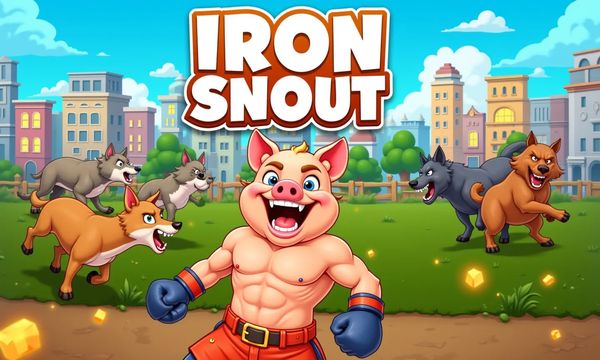
Iron snout turns a fixed-center arena into a frantic test of timing, where one piglet fights through wolves arriving from both sides. Every attack happens at close range, yet the screen never gives you much time to think. You punch, kick, stomp, and launch attacks while reading the next threat.
SnoutUp released this colorful action fighting game in 2016. It stays focused on single-player survival, with no need to manage a large map or complicated loadout. The challenge comes from quick reactions, careful positioning, and handling enemy weapons before the pressure becomes too heavy.
Use the browser version for a fast start, or choose another supported release. Play Iron snout online here and see how long your piglet can survive.
Iron Snout combat loop and survival pressure
Piglet Positioning
The piglet stays near the center of the screen. That fixed position makes every direction matter. Wolves can close in from the left or right, so you must watch both sides instead of guarding one lane.
Use the attack that matches the threat’s location. A left punch or kick handles pressure from the left, while the right version answers an approach from the opposite side. The uppercut or jump attack reaches a different angle, and the ground attack or stomp gives you another close-range option.
Do not stare at one wolf for too long. A successful hit solves only the current danger. The next attacker may already be entering from behind, turning a good response into a costly delay. Keep your attention wide, then commit quickly when a target reaches striking distance.
Wolf Waves
Wolf attacks create constant movement around the piglet. Standard enemies force basic directional reactions, while weapon users change the timing of each exchange. A threat may arrive in person or send an item across the arena.
That mix prevents one repeated attack from carrying every run. Read the incoming side first. Then choose a direct hit, a vertical attack, or an item response. The safest action depends on what the wolf brings and how close the other side has become.
Why Runs End
Runs end when repeated mistakes allow wolves to damage the piglet. One missed reaction can expose you to another attack immediately afterward. Surviving longer means limiting those errors, not simply attacking faster.
Mastering Iron Snout controls and movement
Keyboard Layouts
Iron Snout uses two confirmed keyboard layouts. You can play with the letter keys or the arrow keys, depending on which arrangement feels more natural. Both layouts map the same four combat directions to the same actions.
With the letter layout, W performs the uppercut or jump attack. A performs the left punch or kick. S performs the ground attack or stomp. D performs the right punch or kick.
The arrow layout follows the same pattern. Arrow Up performs the uppercut or jump attack. Arrow Left performs the left punch or kick. Arrow Down performs the ground attack or stomp. Arrow Right performs the right punch or kick.
Pick one layout before chasing better runs. Switching between layouts during practice can slow your reactions, especially when wolves arrive from both sides. Letter-key players can keep their hand centered around W, A, S, and D. Arrow-key players can use the matching directional shape without changing the combat logic.
Focus on direction first, then action speed. If a wolf approaches from the left, press AN or Arrow Left. If danger appears on the right, press D or Arrow Right. Use W or Arrow Up for the uppercut or jump attack, and S or Arrow Down for the ground attack or stomp.
These controls are simple, but the arena makes them demanding. The challenge comes from selecting the right input while another threat develops elsewhere. Short practice sessions help build recognition without adding extra controls to remember.
Start playing Iron snout now and test which keyboard layout gives you cleaner reactions.
Weapons, throws, and enemy item handling
Catching Green-Tagged Items
Some enemy items show green indicators. Those items can be caught and thrown, giving you a way to answer a weapon threat instead of only avoiding it. Watch the indicator as the item approaches, then react with purpose rather than striking at random.
The green tag gives you a useful visual cue during the arena’s chaos. It separates catchable items from ordinary movement and helps you decide when item handling matters. Keep checking both sides, because catching one item does not remove every other wolf from danger.
Throwing Back Enemy Weapons
After catching a green-tagged item, throw it back toward the wolves. This turns an incoming threat into an immediate response. The timing still matters, since another attacker may enter while you focus on the item.
Use the throw as part of your reaction, not as a reason to ignore the opposite side. A quick return can clear pressure, but poor awareness can leave the piglet open to the next attack.
Turning Wolf Tools Against Them
Wolves can be disarmed, so their weapons do not always remain theirs. Catching and throwing items gives the piglet a direct way to control the exchange. Treat each weapon as a timing test, then return it before another threat reaches the center.
Reading wolf attack patterns
Standard Wolves
Standard wolves create the basic rhythm of Iron Snout. They approach without the extra threat of a thrown or powered item, so they test your directional reactions. Watch which side they use, then choose the matching punch or kick.
Their simplicity can become dangerous when several attacks overlap. Do not assume the last wolf you hit remains the only target. Check the opposite side immediately after each response. A standard wolf can still damage the piglet when your attention stays locked elsewhere.
Use the uppercut or jump attack when that action matches the incoming threat. Keep the ground attack or stomp available for close pressure that calls for it. The goal is not to force one favorite move, but to select the cleanest answer for the current position.
Standard enemies also teach the core timing needed for stronger variants. Practice reading approach direction before adding weapon handling. Once that reaction feels natural, you can spend more attention on items and unusual attack paths.
Special Attack Variants
Knife throwers force you to read projectiles. Grandma-style basket throwers add another item-based threat. Lumberjack wolves, pogo-spear wolves, rocket wolves, and chainsaw wolves each change the danger you must read.
These variants reward quick identification. A knife or basket signals item pressure, while a pogo spear, rocket, or chainsaw demands attention to the attacker’s approach. Keep the piglet’s center position in mind, and do not let one unusual wolf hide a standard attack from the other side.
Iron Snout scoring and high-score play
Survival As Score
Score chasing starts with survival. The longer the piglet remains safe, the more chances you have to build a stronger result. A flashy response means little if the next wolf lands a hit because you stopped watching the arena.
Community high-score play focuses on clean reactions over reckless speed. Each run becomes a test of consistency. Handle standard attacks, read special variants, and use enemy items without losing awareness of the opposite side.
Raising Combo Value
To raise combo value, keep your attacks connected to clear decisions. Avoid random inputs that break your rhythm or leave the piglet exposed. A clean response against each threat matters more than pressing keys as quickly as possible.
Use the correct side, choose the suitable attack, and keep moving through each exchange. Strong runs look controlled because every action answers something visible on screen.
Resetting for Better Runs
Replaying helps you look for a cleaner start. Reset when early mistakes teach you little, then focus on sharper first reactions. A strong opening builds confidence and gives your later decisions more room.
Do not treat a reset as wasted time. High scores usually come from repeating the opening until the controls feel automatic.
Try Iron snout here and chase a cleaner run with every attempt.
Age rating, audience, and system needs
Store Ratings Differ
Ratings vary between storefronts. Apple lists Iron Snout at 13+ because of frequent cartoon or fantasy violence. Other stores may use different rating systems or age labels, so the displayed result can change by platform.
These differences reflect regional and storefront standards, not a change to the core fighting concept.
Cartoon Violence Context
Iron Snout presents its combat through colorful cartoon action. The piglet fights wolves with punches, kicks, stomps, uppercuts, and thrown items. The presentation stays stylized, while the fast attacks explain why stores classify the game around cartoon or fantasy violence.
Players should check the rating shown on their chosen storefront before starting.
Low Hardware Demand
The game has low system requirements. Steam lists very small minimum requirements, making the PC release lightweight compared with demanding modern games.
That low demand supports quick sessions on modest systems.
Compare with Similar Games
| Game |
Why Similar |
| Ragdoll Hit |
Both games center on direct melee combat using punch/kick actions against oncoming opponents; in Ragdoll Hit, players can hit, jump, kick, and grab objects during fights. |
| Bullet Bros |
Both games use short round-based combat where the player attacks enemies directly while managing incoming threats in real time. |
✨ Key Features of Iron snout
- Single-player survival brawler
- Arrow-key combat
- Catch-and-throw weapon play
- Enemy weapon disarming
- Fixed-center arena pressure
- Multiple platform releases
How to Play Iron snout
Step 1: Use the game controls
Use W Key to uppercut / Jump attack. Use A Key to left punch/kick. Use S Key to ground attack / Stomp. Use D Key to right punch/kick.
Step 2: Start with the center-lane rhythm
Watch both sides before acting. Iron Snout keeps the piglet fixed in place, so your first job is reading incoming wolves fast.
Step 3: Punch, kick, and slam immediately after contact windows
Attack as wolves enter range. The core controls let you answer with fast strikes instead of waiting for openings.
Step 4: Catch items with green indicators
When an item shows a green cue, grab it instead of ignoring it. Those moments let you turn enemy attacks into your own offense.
Step 5: Throw enemy weapons back quickly
Use caught weapons against the next wolf wave. Returning their own tools is one of the safest ways to stay alive longer.
Step 6: Learn which enemy type is arriving
Knife throwers, basket throwers, lumberjacks, pogo-spear wolves, rocket wolves, and chainsaw wolves all force different reactions. Recognizing them early saves runs.
Iron snout FAQs
Does Iron snout require a separate installation?
No. The browser version of Iron snout runs on the page without a separate installation.
Conclusion
Iron snout is a focused HTML5 action fighting game from SnoutUp, released in 2016 for browser play. Its appeal comes from a clear singleplayer experience and responsive keyboard controls that keep every action easy to understand. Use W or Arrow Up for an uppercut / jump attack, AN or Arrow Left for a left punch/kick, S or Arrow Down for a ground attack / stomp, and D or Arrow Right for a right punch/kick.
This straightforward control scheme makes Iron snout enjoyable to pick up while still giving each direction a distinct purpose. With its compact presentation, direct action, and accessible browser format, it is a great choice for a quick session. Play Iron snout right here on this page and see how it feels for yourself.


No comments yet. Be the first to share your thoughts!