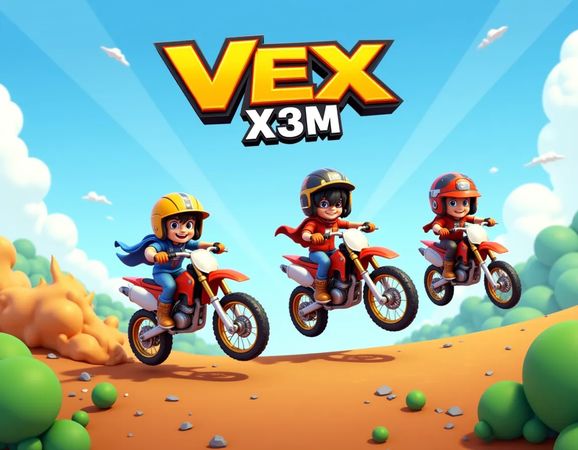
Vex x3m turns a motorcycle run into a fast test of balance, timing, and nerve. You race across steep obstacle courses, launch into the air, and fight to reach the finish line without losing control. Every ramp creates a new choice: stay safe, or push for a faster run.
This browser motorcycle stunt game blends the speed of hill racing with platformer-style hazards. Acceleration gets you moving, braking helps control landings, and bike tilting keeps the rider steady during jumps. Checkpoint flags also give each attempt a clear rhythm, so one mistake does not erase the entire run.
Learn the track, control each jump, and use flips when the landing looks safe. Play Vex x3m online now, then chase a cleaner finish with every attempt.
Vex x3m core loop and win condition
Finish-line pressure
Each run begins with one clear goal: reach the finish line. The bike moves through a designed obstacle course filled with ramps, gaps, uneven ground, and sudden changes in height. You must keep forward speed while guiding the bike over every section.
That balance creates the game’s main pressure. Slow down too much, and the next jump may become harder. Push too quickly, and the bike may land at a poor angle. A successful run depends on reading the course early, not just reacting after the bike leaves the ground.
Vex x3m feels different from a standard motorcycle racer because the track itself demands control. You are not simply following a flat route around rivals. You are climbing, launching, tilting, and correcting your bike through a compact stunt course. The finish line rewards completion, but the route tests every movement before it.
Short sections can still create tense moments. A small bump may lift the front wheel. A steep slope may change the bike’s balance. Keep watching the surface ahead, and treat each landing as the start of the next move.
Why every second matters
Speed shapes every decision. Acceleration helps clear obstacles, but uncontrolled speed makes landings harder. Braking gives you a way to settle the bike before contact with the track.
Time shaving comes from small improvements. Take a jump with less hesitation. Hold a clean line across a slope. Recover quickly after a rough landing. These gains build across the whole course.
Flips also connect movement with pace. The game ties front flips and backflips to faster runs, so aerial control matters beyond style. The best approach combines forward progress with careful timing.
The platformer-racer crossover
Vex x3m combines racing goals with platformer movement. You need speed, but you also need precise positioning on ramps and elevated sections. Bike tilting becomes as important as acceleration.
That mix makes each obstacle feel like a short movement challenge. Read the next surface, choose your angle, and correct the bike before landing. The course sets the test; your timing decides the result.
Controls and bike handling
Acceleration and braking
Use Arrow Up to accelerate and move forward. This input drives the bike across flat ground and helps build momentum before ramps. Hold it when the path looks clear, but release your rush when the next landing needs more care.
Press Arrow Down to brake, reverse, or land smoothly. Braking can reduce unwanted rotation before the wheels touch down. It also helps when the bike reaches a slope faster than expected.
Think of these controls as a pair. Arrow Up creates movement, while Arrow Down manages that movement. Strong runs rarely hold one input without thought. Instead, they switch between speed and control as the track changes.
Use R to restart the level after a poor attempt. Press Escape to pause or open the menu. Restarting quickly helps you test a new approach without wasting time after a mistake.
Tilting for balance and flips
Arrow Left and Arrow Right tilt the bike. Use them to balance the frame during jumps and to perform flips while airborne. Small taps often work better than long holds.
Watch the bike’s angle, not just its position. A wheel-first landing needs a different correction from a nose-heavy descent. Start your adjustment early, then ease off before the bike reaches the ground.
Tilting also controls front flips and backflips. Keep the rotation measured. A stylish move only helps when the bike returns to a stable landing.
Vex x3m gameplay
How flags save progress
Checkpoint flags divide the run into useful progress points. When you reach one, it marks a place within the course. That changes how you approach difficult sections because a mistake later does not force you to treat the whole level as new.
Flags also create natural learning stages. First, focus on reaching the next flag. Then study the obstacle section that follows it. This method keeps the course manageable and gives each attempt a clear target.
Use the flags to judge risk. Before reaching one, protect the run and avoid needless drama. After reaching one, you can test a faster line through the next group of obstacles. The system supports practice without removing the pressure of the finish line.
Do not treat a checkpoint as permission to stop thinking. The bike still needs a clean path after the flag. Look ahead, keep your balance, and prepare for the next change in the track.
What happens after a crash
A crash ends the current push through that section. You lose the clean run and must try again from the relevant starting point. The R key lets you restart the level quickly when the attempt has gone badly.
Use each crash as clear feedback. Did the bike reach the ramp too fast? Did the frame tilt too far? Did braking begin too late? Identify one cause, then change that movement on the next attempt.
Checkpoint progress makes this process less frustrating. You can focus on the difficult part instead of repeating every earlier section with no plan.
Why checkpoint timing matters
Checkpoint timing changes your risk choices. Protect progress near a flag, then experiment after reaching it. That simple rhythm helps separate safe racing from useful practice.
Reach each flag with control. A rushed approach can leave the next section harder than expected. Smooth progress gives you more options.
Air tricks and time shaving
Front flips and backflips
Vex x3m lets the bike perform front flips and backflips while airborne. Use the left and right tilt controls to rotate the bike during a jump. The direction of your tilt shapes the movement, so watch the frame as it turns.
These tricks are not separate from racing. The game ties them to faster runs, making aerial movement part of pace control. A well-timed flip can keep the run moving with purpose instead of treating every jump as a simple hop.
Start the rotation after the bike has enough space. Then watch the wheels and frame together. Stop correcting once the landing angle looks stable. Over-rotating creates trouble at the exact moment you need control.
Practice one flip at a time. Learn how much tilt the jump allows before adding speed. Consistent movement matters more than dramatic rotation.
When to attempt tricks
Attempt a trick when the bike has clear air and enough room to recover. A broad gap gives you more time to watch the rotation. A short jump demands quicker judgment.
Check the landing before committing. If the ground rises sharply, reduce rotation early. If the bike must touch down immediately, favor balance over extra movement.
Use the course layout as your guide. Do not force a flip on every ramp. Choose jumps that leave space for a controlled return to the track.
Trading safety for speed
Tricks add a risk to every jump. A faster run means little if the bike lands badly. Keep the safest line when the next obstacle follows too closely.
Take bigger chances after learning the section. First, reach it consistently. Then add a flip and compare the result. That approach turns risk into a measured choice.
Good time shaving comes from control, not panic. Keep the bike moving, but protect the landing.
Try Vex x3m right here and turn your next clean jump into a faster run.
Reading level hazards and tile types
Obstacle timing
Obstacle courses test timing more than raw speed. Watch how the track rises, drops, and changes under the bike. Start your tilt before the jump becomes urgent.
Approach each obstacle with a plan. Use acceleration when the bike needs distance. Use braking when the landing demands a calmer angle. Then correct the frame with the tilt controls.
Timing matters because one movement often affects the next. A late correction may save one landing but ruin the following slope. Look beyond the immediate obstacle and prepare for the surface after it.
Keep your inputs measured. Quick corrections can help, but wild movements make the bike harder to read. Learn the rhythm of each section through repeated attempts.
Sand and trap sections
Levels use different tile types, including sand and trap sections. These surfaces change how you read the route. Do not assume every patch responds like ordinary track.
Slow your decisions when the tile looks unfamiliar. Keep the bike balanced, then adjust speed around the section. A careful approach gives you time to recognize what comes next.
Use checkpoint progress to practice these areas. Learn their shape first. Chase a faster line only after the movement feels predictable.
Why visual recognition matters
Visual reading helps you act before danger arrives. Spot a new tile, ramp, or obstacle early. Then choose acceleration, braking, or tilt with a clear reason.
Strong players read the next two movements, not just the current one. They notice the landing surface before starting a flip. They also recognize when a safe line offers better control.
Keep your eyes on the course. The bike follows your timing, and the track gives you the clues.
Where the game sits in the Vex and X3M series
Crossover identity
Vex x3m sits where the Vex world meets motorcycle stunt racing. Its identity comes from that blend. You get a browser motorcycle game, but the course behaves like a movement challenge rather than a simple road.
The X3M side shows through the focus on speed, ramps, airborne tricks, and finish-line racing. The Vex side appears in the obstacle-course structure and the need for careful platform-style movement. Neither part works alone. Speed creates momentum, while precision keeps the bike alive.
Its core mechanics stay easy to understand. Arrow Up accelerates. Arrow Down brakes, reverses, or helps smooth a landing. Arrow Left and Arrow Right tilt the bike for balance and flips. Checkpoint flags divide the run, while front flips and backflips add another way to manage pace.
That combination gives Vex x3m a clear place in the series. It is not only a racer, and it is not only a platformer. It asks you to cross each obstacle course quickly, read every landing, and improve through repeated runs. Because it runs directly in the browser, you can return to that challenge immediately and keep refining your control. Master Vex x3m today and launch into another run below.
2D vehicle control on uneven terrain where balancing the vehicle is part of reaching the goal
✨ Key Features of Vex x3m
Checkpoint flags
Front flips
Finish-line racing
Bike tilt control
Obstacle courses
Time shaving
How to Play Vex x3m
Step 1: Use the game controls
Use Arrow Up to accelerate / Move Forward. Use Arrow Down to brake / Reverse / Land Smoothly. Use Arrow Left to tilt Bike (Balance/Perform Flips). Use Arrow Right to tilt Bike (Balance/Perform Flips).
Step 2: Build speed early
Use acceleration to reach a stable pace before the first hazard cluster.
Step 3: Tilt before you land
Adjust the bike angle in the air so the wheels meet the ground cleanly.
Step 4: Treat flags as recovery points
Ride through checkpoint flags whenever the line is safe and straight.
Step 5: Take tricks only on safe jumps
Use front flips or backflips when you can still land cleanly.
Step 6: Brake before awkward sections
Slow down when the next obstacle requires precise angle control.
Step 7: Restart only after a ruined run
If repeated crashes kill your pace, begin again instead of forcing a bad time.
Vex x3m FAQs
What are the basic controls for Vex x3m?
Browser keyboard: Arrow Up — accelerate / move forward; Arrow Down — brake / reverse / land smoothly; Arrow Left — tilt bike (balance/perform flips); Arrow Right — tilt bike (balance/perform flips); R Key — restart level; Escape Key — pause/menu.
Conclusion
Vex x3m is a fast-paced browser action game built around precise bike control and daring aerial tricks. In singleplayer, you can accelerate with the Arrow Up key, use Arrow Down to brake, reverse, or land smoothly, and tilt the bike with the Arrow Left and Arrow Right keys. While airborne, front flips and backflips add an extra test of timing and balance.
These tricks are more than decoration: they are tied to faster runs, rewarding players who can combine controlled landings with confident movement. If a run goes wrong, press R to restart, or use Escape to pause and open the menu. Take control of the bike, practice your flips, and play Vex x3m right here on this page.
Vex x3m Game Video
YouTubeWatch Gameplay
Game Controls
Arrow Up
Accelerate / Move Forward
Arrow Down
Brake / Reverse / Land Smoothly
Arrow Left
Tilt Bike (Balance/Perform Flips)
Arrow Right
Tilt Bike (Balance/Perform Flips)
R Key
Restart Level
Escape Key
Pause/Menu
No comments yet. Be the first to share your thoughts!


No comments yet. Be the first to share your thoughts!